
Coin sweep
A sweep takes one setting and runs it across every coin in the universe on the same window. It answers whether a result came from the strategy or from the one coin it happened to be tested on.
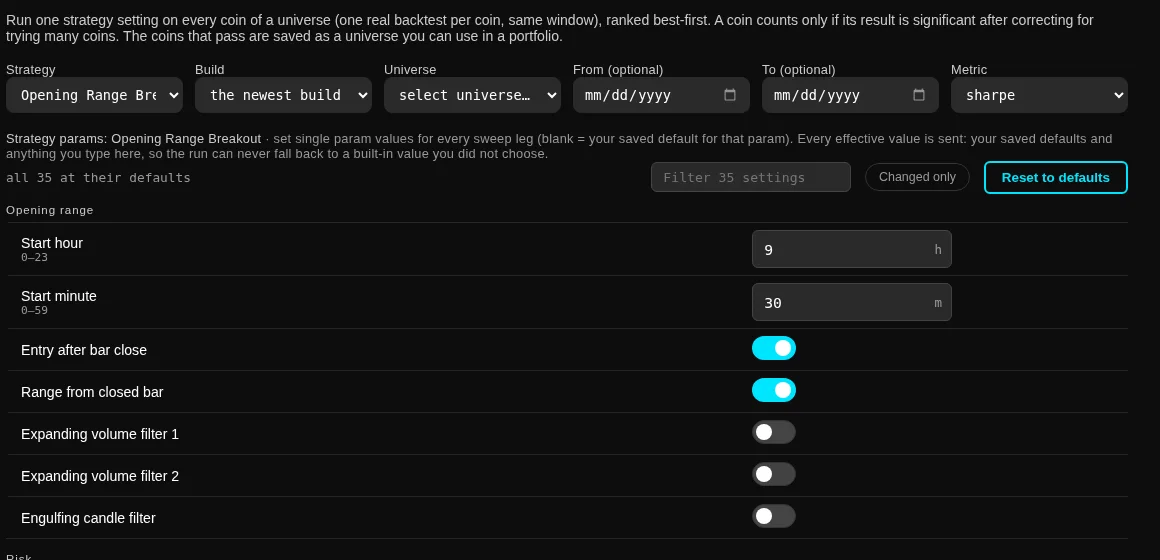
The form
The Sweep tab opens on the strategy you last chose, with a build picker beside it. An empty build picker means the newest build at the moment each measurement runs, and a build that is no longer on disk is refused by name before the sweep starts. The window, the timeframe and the fill data are the same fields as a backtest, and the settings the strategy runs with are listed with the ones you changed highlighted.
An Advanced section says what the sweep will need before you start it, for example about five gigabytes of memory and two of disk for the full Bybit universe, and how many run at once.
The guard
A sweep is held to the machine's free memory and free disk. Below the pause floor no new coin starts until memory recovers, and below the stop floor the job stops cleanly with a plain sentence saying so. A stopped sweep keeps every result it already has and writes no selection universe, and its card says only that many coins were screened of how many.
A coin whose leg was cancelled by the memory guard is queued again and runs from the start once memory is back above the resume floor, at most twice, so three attempts in total. A cancel or a stop by you never retries anything.
Every coin ends somewhere
Each coin in the universe finishes as measured, failed, skipped with its reason, or waiting to be retried. Nothing is dropped without a line. The count of coins measured is against the size of the universe and not against the number of rows, so a sweep of a hundred coins that finished sixty says sixty of a hundred and lists the rest by name.
The result
A finished sweep opens on its own tab. A summary line says how many coins made money, the median, best and worst result, and how many were statistically significant. One line per coin follows, with the return, the net profit and loss, the trade count and the venue symbol. The data store is named once when every coin used the same one.
A leg does not keep its chart, which is what keeps a sweep small. Its result says so and offers a re-run, which opens the leg with its chart and indicators.
Getting there from a study
From an optimisation, a row's own action opens the sweep with the strategy, the timeframe, the window and that row's values already filled in. That is the usual way to find out whether a plateau is a property of the strategy or of one market.