Fill settings
A paper instance fills against a live market with a simulated exchange, so the price it gets is a model. The knobs on this page decide how optimistic that model is, and they are the same knobs a backtest answers to, which is what makes a paper result comparable with one.
The Fills group
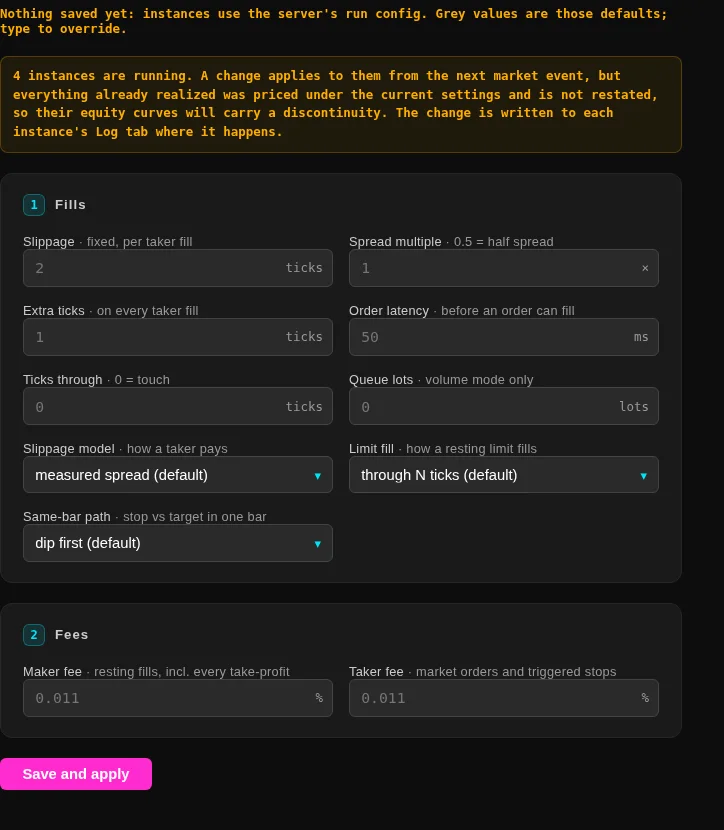
- Slippage, in ticks per taker fill. It is the fixed adverse move the simulation gives every market order and every triggered stop, and it is also the fallback when no spread can be measured.
- Spread multiple, the fraction of the measured spread a taker gives up. 0.5 is the standard half spread, and 1 charges the whole spread.
- Extra ticks, added on top of every taker fill as one allowance for latency, queue position and reaction time.
- Order latency, in milliseconds. A resting order is not fillable until its placement plus this delay, so a limit order placed onto a move that has already happened does not fill in the same instant.
- Ticks through, how far past a resting limit price the market has to trade before the order fills. Zero fills on a touch.
- Queue lots, the size assumed ahead of you at the price level. It is read by the volume fill mode and ignored by the others.
- Slippage model and Limit fill choose between the measured spread and a fixed number of ticks, and between filling through a number of ticks and filling by queue position.
- Same-bar path decides the one order of events a bar cannot tell you. When the stop and the take-profit are both inside the same bar, the simulation has to choose which came first, and this setting chooses: dip first reads an up bar as open, low, high, close and a down bar as open, high, low, close; high first always reads open, high, low, close; low first always reads open, low, high, close.
Each of these has its own page: Fills and slippage, Spread, Limit fills and queue lots and Latency.
The fees
The Fees group takes a maker and a taker fee. The maker fee is charged on a resting fill, which includes every take-profit leg, and the taker fee on market orders and on stops that trigger. Both are a percentage, and both are charged on the notional of the fill that incurred them.
Saving while instances run
Saving applies to every instance that is running and to every instance started afterwards. A running instance takes the change from its next market event, and nothing that was already realized is priced again: the equity curve keeps a discontinuity at that point instead of pretending the past was always costed the new way. Each instance's log gets a line where the change happened, so the step in the curve has a cause you can read.
Where the simulated spread comes from
A paper instance reads the live order book, so the spread it charges is a measurement of what crossing costs at that moment, not an estimate. The simulation takes the best source it has at each fill: the quoted spread first, then an estimate inferred from the trade tape, then the fixed slippage above. A crossed book, a deleted touch or a gap in the sequence withdraws the quote rather than leaving a stale one in place, and the card counts those withdrawals.
A backtest never has a quote, so it always prices from the trade tape. That is a real difference between paper and backtest, it is measurable rather than mysterious, and it is usually the first thing to look at when the same strategy earns more in one than the other.