
Instances and portfolios
Live trading is paper trading's machinery pointed at accounts a venue owns the truth for. The cards, the account headers, the eight tabs and the portfolios are the same ones; what changes is where the numbers come from and which controls are worth knowing before you need them.
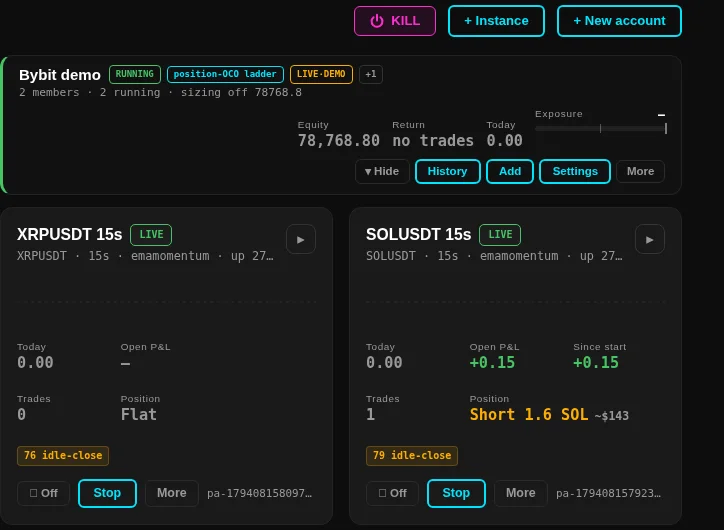
What the live environment adds
- KILL, the emergency stop, which exists only here. It cancels every order on each live instance's coin, closes the position reduce-only, confirms with the venue that the position reads flat, and stops the instance so nothing restarts it.
- Exchanges, the page of exchange-level master accounts and their transfers, described in Connecting Bybit.
- Two connection paths in the header instead of one: FEED for the market tape, which paper shares, and REST for the signed order path to the venue, which paper has no equivalent of. Both are measured by the engine itself, so a dead order path is visible even while the tape flows and even with no instance running.
What is not here
There are no fill knobs in the live environment. Slippage, spread, latency, queue position, fees and the same-bar path belong to a simulation, and a live order gets whatever the venue gives it, so those settings do not exist here. The live Settings page carries the appearance and the count of running instances, nothing that would change a fill.
There are also no position-size or divergence warnings on a live card. A live position is Bybit's position, taken as the venue reports it, so there is nothing to reconcile it against; the card shows the side, the quantity, the average entry and the venue's own P&L.
The account header
It reads like a paper account's, with three differences worth reading twice. The network is printed next to the account name (LIVE DEMO in the figure above), the bracket model the account uses is one chip away from it, and the balance is the venue's number with the age of the read that produced it. An account this machine holds no key file for says so in its chip instead of pretending to a balance.
Restarting a live instance
A live instance that stops and starts again adopts whatever position and open orders Bybit holds for its coin and account, and carries on from there. It does not replay its own history: the strategy cares about the position that exists. Trades made while it was down are read back from the venue and booked, whoever placed them, so the ledger and the venue agree.
If the stored trades or the venue cannot be read at restart, the card says RESTART NOT VERIFIED and nothing is booked or invented. A paper instance behaves differently on restart, and Paper versus live says how.
Live portfolios
A portfolio works the same way live as it does on paper: one account, one selector, one universe strategy, and a rotation that starts and stops coins inside that account only. A live portfolio may only bind a live account that holds exchange keys and is empty and unbound, and the instances its rotation creates are built through the same path as a hand-started live instance, so they are live instances rather than something adjacent to them.
Rotation pause, the daily selection and the screener database remain one switch for the whole engine across both environments, and the portfolio's own rotation switch stays in its own edit dialog.
The two stops
A plain stop is the everyday action: the instance stops, and its position and resting orders stay on the venue until you close them or the strategy's own orders finish the job. The kill switch is the other one, and it is destructive on purpose: orders cancelled, position closed, instance stopped and left stopped. Operator stop and kill switch spells out both.